I was looking for a desktop blogging client for an aspiring photo blogger. The one that seemed to meet all the requirements (free, works on a Mac, easy to upload photos stored in iPhoto, support for Wordpress) is ScribeFire. It’s a plugin for Firefox and seems to be highly regarded by many bloggers. Uploading photos is as simple as clicking the “Add an image” button on the toolbar, and it will upload via FTP or Wordpress’s blogging API (XML-RPC, I guess). When it opens the browse dialog for uploading photos, it selects the “Photo” media folder by default, which (as Mac users would already know) contains all your photos from iPhoto and Photo Booth.
ScribeFire also adds an item to Firefox’s right-click pop-up menu, which lets you easily create blog entries about web pages (and makes re-blogging a cinch).
The one downside compared to other desktop blogging tools such as Ecto is that you can’t do true image resizing from within ScribeFire itself. If you’re doing photo blogging, though, presumably you’ll be using some other image editing tool to get the photo looking just right before you publish it anyway, so I don’t see this as a major drawback.

It’s been a while in the making, but augmented reality on your mobile is just about here. And by that, I mean that these applications are available for your mobile phone, and it will only be a matter of time before they gain critical mass. So what am I talking about?
In the research space, among others I can refer you to iCam (2006) and MARA (2006) from researchers at Georgia Tech and Nokia respectively. iCam allows the placement of virtual sticky notes on objects in the physical world, through a mobile device. This is neat, since the sticky notes only appear to those whom you want to see them. A limitation of iCam is that, while placement of these sticky notes is very accurate, it only works indoors. MARA overlays information about the real world (and even the people in it if information about objects is being streamed from a central server) in real time.
The there’s this concept device from petitinvention, which takes the idea a few steps further. The user can see information about buildings and locations overlaid on the video stream from the mobile device’s camera. But the same tool can be used to select text from a piece of paper (like a newspaper). Essentially, it’s an augmented reality search tool.
In the commercial/start up realm, a couple of companies have been creating a bit of buzz. First there’s Enkin. Enkin has been developed for the Google Android mobile phone platform. It enables users to tag places and objects on Google Maps, and then to see these tags overlaid on the real world as you walk around with the phone. My favourite is Sekai Camera from Tonchidot. I’m not going to explain it. Just watch the video below. But note that even products on the shelves in shops are tagged in the virtual world and overlaid on the real world. And it’s a very social application.
There’s probably still all sorts of hurdles to overcome, but what a great presentation.
Just in case the world ends tomorrow in a haze of sub-atomic particles, there is something I must confess: I ate the last papadum.
I’ve been playing with Many Eyes from IBM Alphaworks. It’s a visualisation tool for data sets of various sorts. To test it out, I uploaded my Olympic medals per kilotonne of carbon emissions data sets. You can see the data sets here and here, and the resulting bar charts here and here, respectively (Java required).
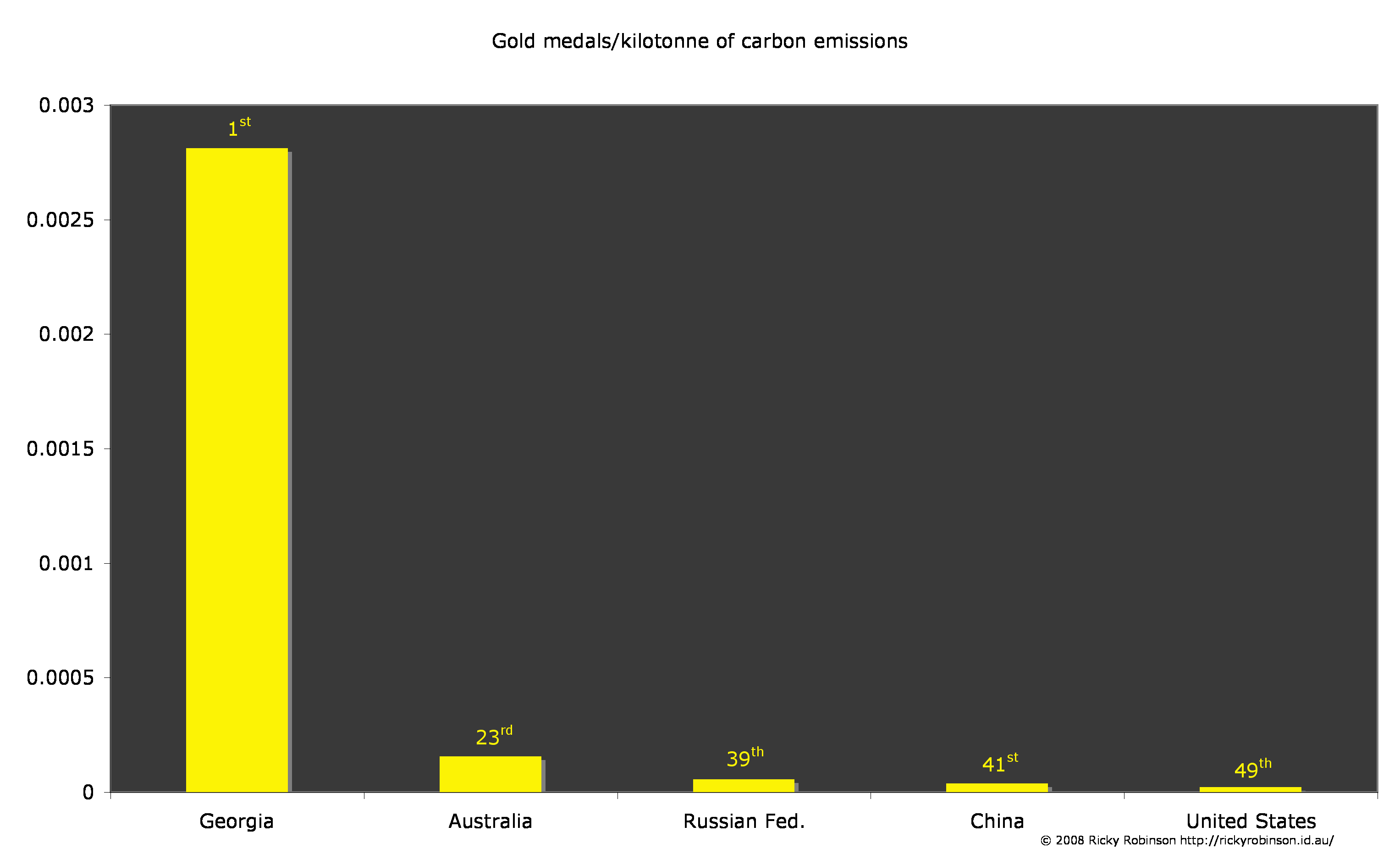
Georgia, it seems, may finally have reason to celebrate after what’s been a tough few weeks for the former Soviet nation. A revised tally of the 2008 Olympic gold medal count, which adjusts the tally according to carbon emissions, puts Georgia at the top of the rankings, well ahead of its nemesis, Russia. Jamaica, Ethiopia, Kenya and Cameroon round out the top 5 in the revised tally.

Australia, Russia, China and the USA are left trailing by some margin, as shown in the figure below.

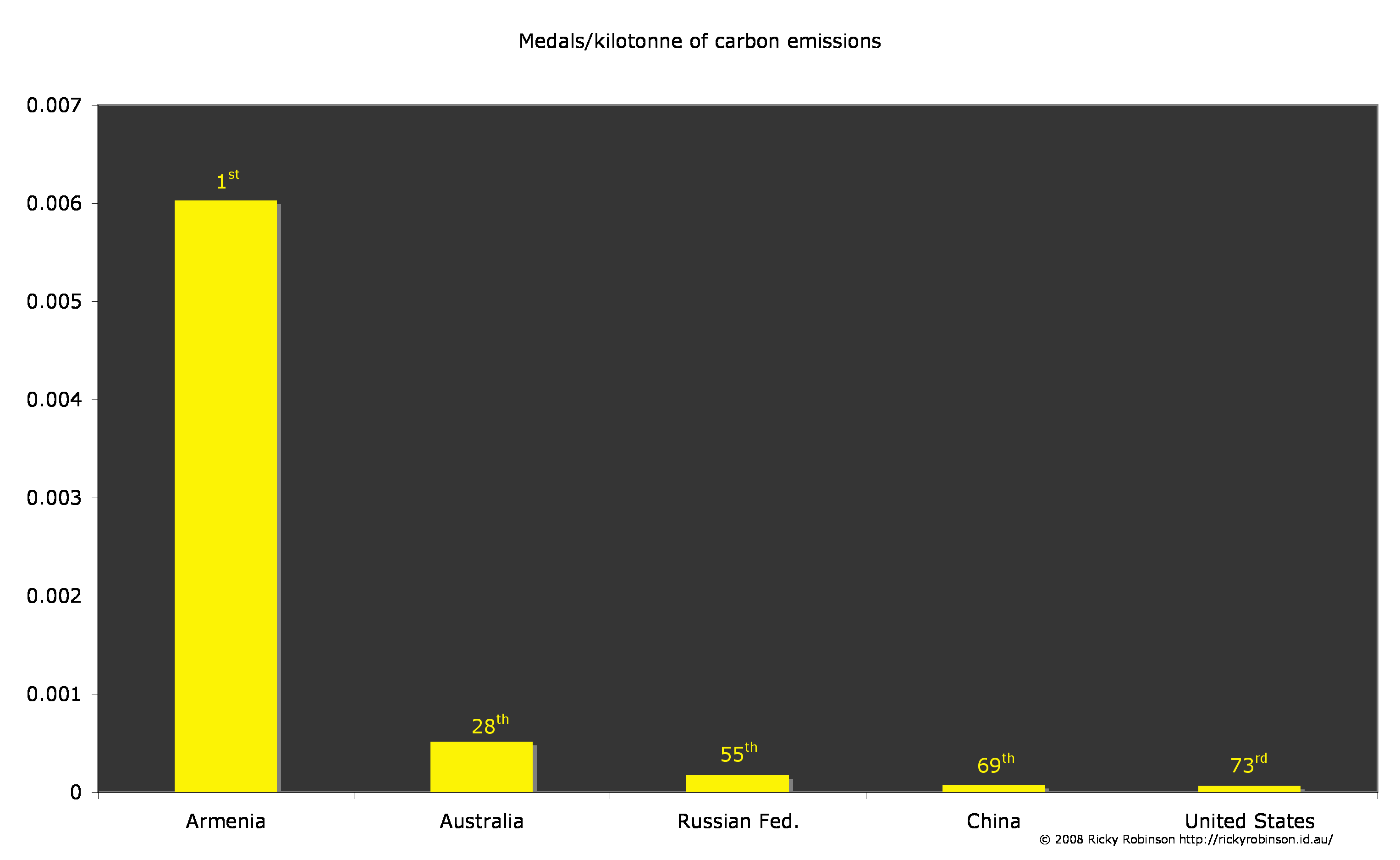
Armenia tops out the revised ranking when all medals are taken into account.

It gets even worse for the traditional powerhouses of Olympic sport.

Notes:
- The medal tally is from the official overall medal standings for the Beijing 2008 Olympic Games.
- Emissions data is from CDIAC – A Compendium of Data on Global Change. This means the emissions data is from 2004 (i.e., it is a little out of date). Anyone know of a complete set of more up to date data?
- This article is, of course, for your amusement only; this analysis is completely meaningless, and should not be cited as evidence in any argument (in pubs, courtrooms, scientific conferences or elsewhere).
This is bizarre. Ryan Seacrest of KIIS FM and E! was doing an interview of Jennifer Garner and Laura Linney at the Oscars when Gary Busey interrupted the interview and kissed Garner on the neck. The next day, Busey calls Seacrest on his radio show and, well, I’m not going to try to explain it. Just listen to it. Watch the Oscars incident first…
… then visit this site and click the first “play” button on the right.
Credit to the Breakfast program on Triple J for bringing this to my attention a few weeks back.
So, the last day of Movember has arrived, which means, tomorrow, my mo disappears. I’m in the awareness raising game rather than the money raising game this year, because I couldn’t get my act together. Maybe next year. Anyway, if you feel like donating some money to the Movember cause, I’m sure Michael and/or Jim would love a last-minute sponsorship.